Corrode
Resonator and erosion plugin for macOS and Windows
A tuned body, and the grit that eats it.
No audio demo for Corrode.
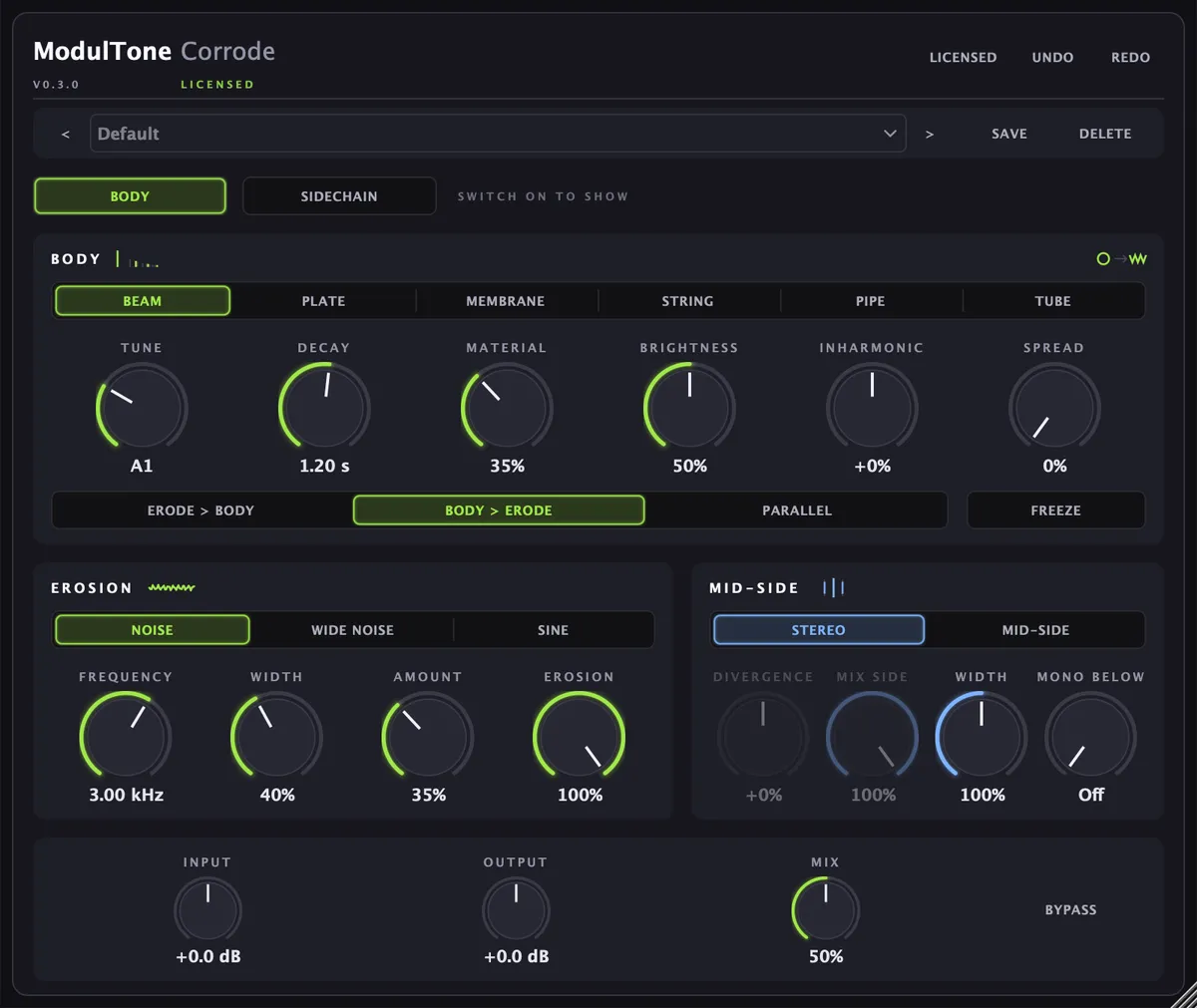
A resonating body tuned to a note, and a sub-millisecond delay modulated by noise that degrades it. The switch that matters is which one happens first. Erode > Body feeds the body something already broken, so the grit is in the note. Body > Erode rings it clean and degrades the result, so the grit is on the note. Same two engines, two different sounds. In Mid-Side mode a single Divergence knob sets how far the sides depart from the centre: tighter and drier one way, looser and dirtier the other. Freeze holds the body where it is and stops feeding it, which is a parameter you can automate onto a downbeat.
Body types
Beam
Modal. A struck bar: partials spread wide of a harmonic series, and the high ones die first.
Plate
Modal. Dense and inharmonic, with partials nowhere near a harmonic series. The only honest way to place them is one at a time, which is what a modal bank does.
Membrane
Modal. Drum-like ratios. Short decays read as a skin, long ones as something metallic stretched over a frame.
String
Waveguide. A tuned delay with damping and dispersion in its feedback loop, which is how a real stiff string goes sharp up top.
Pipe
Waveguide. Open-tube behaviour, hollow, and the most forgiving of the six under heavy erosion.
Tube
Waveguide. Closed and narrower than Pipe, with an odd-harmonic emphasis that sits well under a vocal.
What it does
- Six body types across two engines: Beam, Plate and Membrane are modal banks, String, Pipe and Tube are waveguides
- Three routings: Erode > Body, Body > Erode, and Parallel from the same excitation
- Tune is continuous over six octaves and reads as a note name with the cents offset when there is one
- Decay from 20 ms to 20 seconds, with Material, Brightness, Inharmonic and Spread shaping how the partials die
- Erosion in three modes — mono noise, per-channel noise, or a sine — with frequency, bandwidth and amount
- The erosion modulator is level-normalised, so Amount means the same thing at every bandwidth and doesn't change meaning when you switch mode
- Divergence sets how far the sides depart from the centre in Mid-Side mode, on one bipolar control
- Mono Below collapses the low end up to 400 Hz, and Width runs from 0 to 200% on the way out
- Sidechain input can excite the body instead of the main signal, and the pitch can follow MIDI or track the key
- Freeze holds whatever the body is ringing and stops feeding it. It is a parameter rather than a button, so it can arrive on the downbeat
- An envelope follower points at Erosion, Decay or Brightness — one destination at a time, with a bipolar Depth that ducks where positive opens
- The follower reads in decibels, so it behaves the same on a quiet track as a loud one, and its Speed knob sets attack and release together at a fixed 1:50
- Body and Sidechain each have an enable switch, and the window gets shorter when one is off
Specs
- Formats
- VST3, AU
- Requirements
- macOS 11 or later (Apple Silicon & Intel), VST3 or AU host · Windows 10 or later (64-bit), VST3 host