ModulTone — Mid/Side mixing pluginsTreat your middle and your sides differently.
Saturation, compression, transient shaping, clipping and multiband compression, each with its own controls and independent character control for mid and side.
Level-matched · both takes run in sync
You are hearing MS Saturator — was €69 €45
A stereo file is already two signals.
The mid is whatever both speakers play the same. The side is whatever they don't. Give each one its own controls and the kick stops fighting the room reverb for the same knob.
It works the same on a vocal, a drum bus or a finished master — anywhere the middle and the edges of the image need different treatment.
MS Saturator
FlagshipMid/side saturation plugin for macOS and Windows
Put it on the mix bus and turn up the drive.
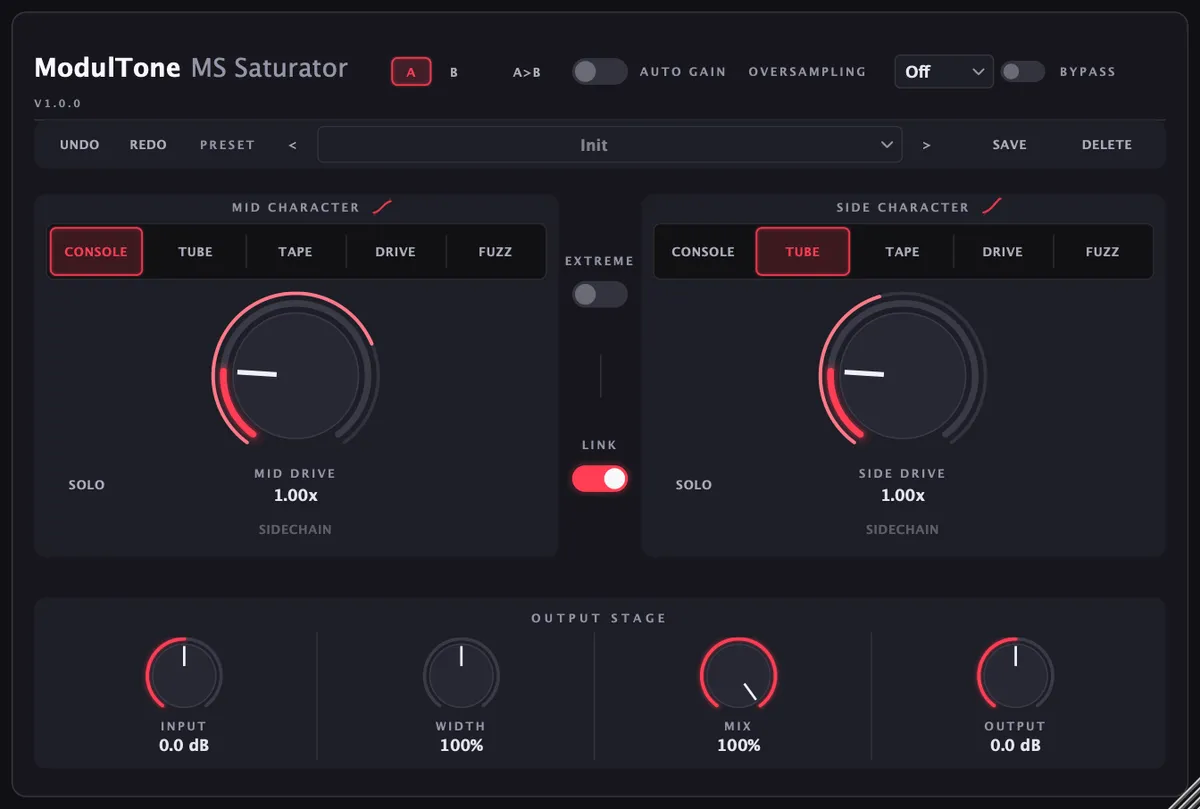
- Independent character modes for mid and side channels: Console, Tube, Tape, Drive, Fuzz
- Extreme mode pushes each character stage past its normal range
- Link ties mid and side drive to a single control
- Built-in oversampling reduces aliasing at high drive settings
The demo at the top of this page is this plugin.
The Mid/Side Core
was €249 €149
All 6 paid plugins together, for €149 instead of €238 one at a time. You save €89.
See the bundle- MS Saturator
was €69€45 - MS Field
was €49€35 - MS Clipper
was €69€45 - MS Compressor
was €49€35 - MS Punch
was €59€39 - MS MultiComp
was €59€39 - One at a time€238
- Together
was €249€149
The rest of the toolkit.
Same idea, applied to the other jobs that come up: metering, clipping, compression, transient shaping, and multiband work.
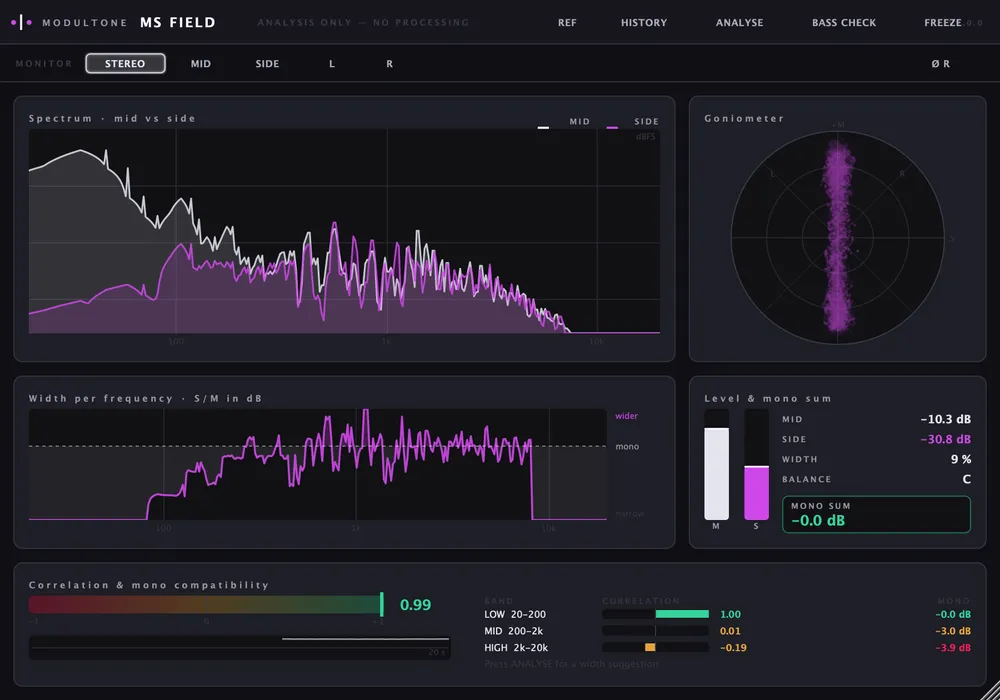
MS Field
Mid/side metering plugin
See the fold to mono before you make it.
The spectrum, the correlation and the mono-loss numbers all come from the same 2048-sample frame, so the picture can't show a wide-looking curve next to a reading that says otherwise. Three bands read correlation and mono-loss at a glance, in the same green-amber-red a level meter uses. Bass Check swaps in a frame four times longer, so the ten third-octave rows below 200 Hz are built from around seventy bins instead of eight — and it names the frequency causing the trouble and how many decibels a mono fold below it would give back, instead of leaving you to guess from a wobbling needle. It doesn't touch the audio. Everything here is read off the input, and the signal passes through untouched.
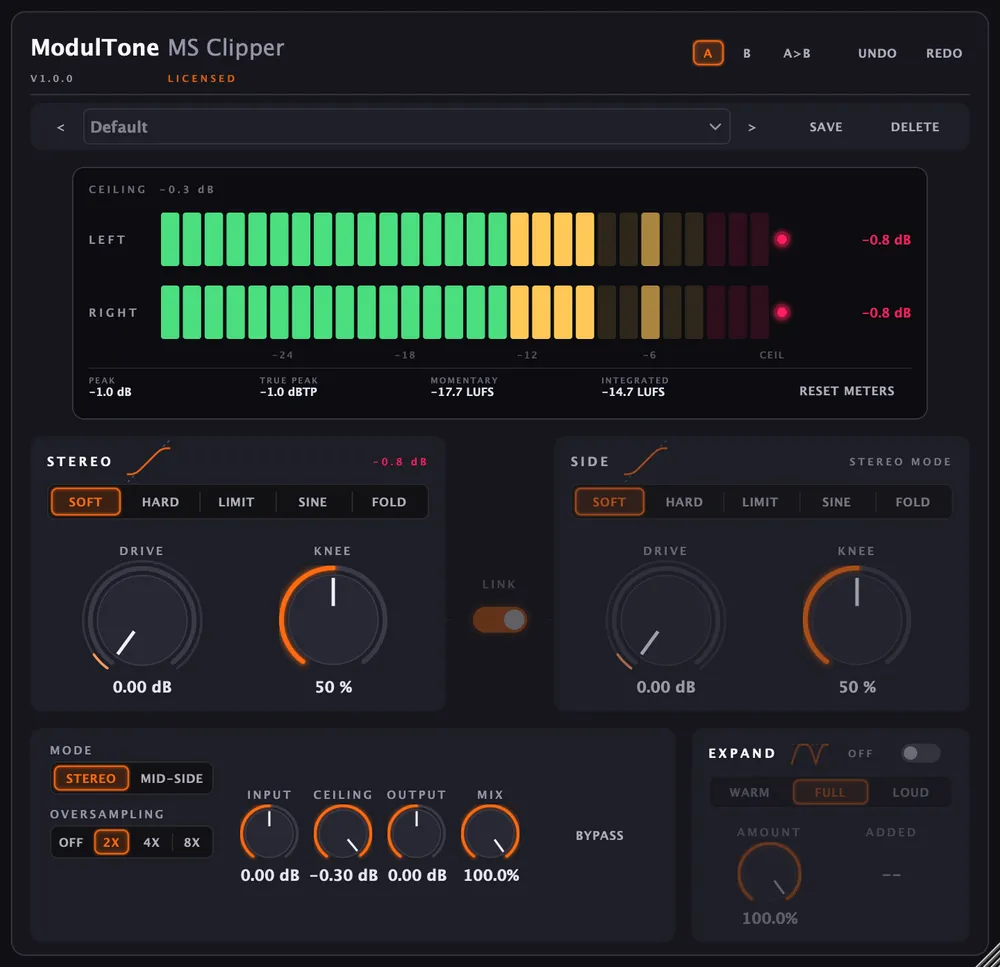
MS Clipper
Mid/side clipper plugin
Clip the centre and the sides on separate curves.
Hold the middle with Limit so the vocal and the kick keep their shape, and run the sides through Fold, where the waveform turns back on itself and the cymbals get their edge. Both lanes have their own shape, drive and knee. Clipping the mid and the side separately is a different operation from clipping left and right separately, even with identical settings on both. A nonlinearity does not commute with the mid/side matrix, which is why the Stereo/Mid-Side switch is a mode of its own.
Press play, then switch. Both takes run in sync
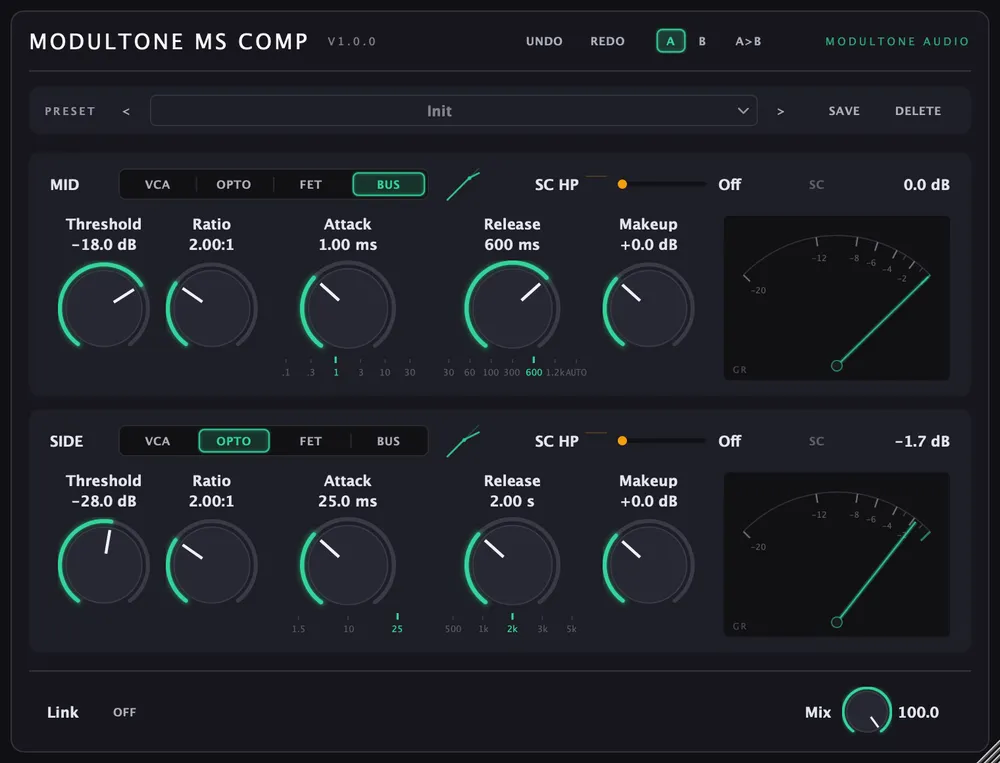
MS Compressor
Mid/side compressor plugin
Give the mid and the side their own compressor.
Four detector types per channel, so the Mid can ride an Opto's slow, level-dependent release while the Side gets an FET's fast grab on transients. Two compressors doing two jobs on the same signal. Link them when one set of controls is enough, split them when the mix asks for two. Secret sauce: squash your overheads to extremes on the Side.
Press play, then switch. Both takes run in sync
MS Punch
Mid/side transient shaper plugin
Keep the centre punchy and dry the room in the sides.
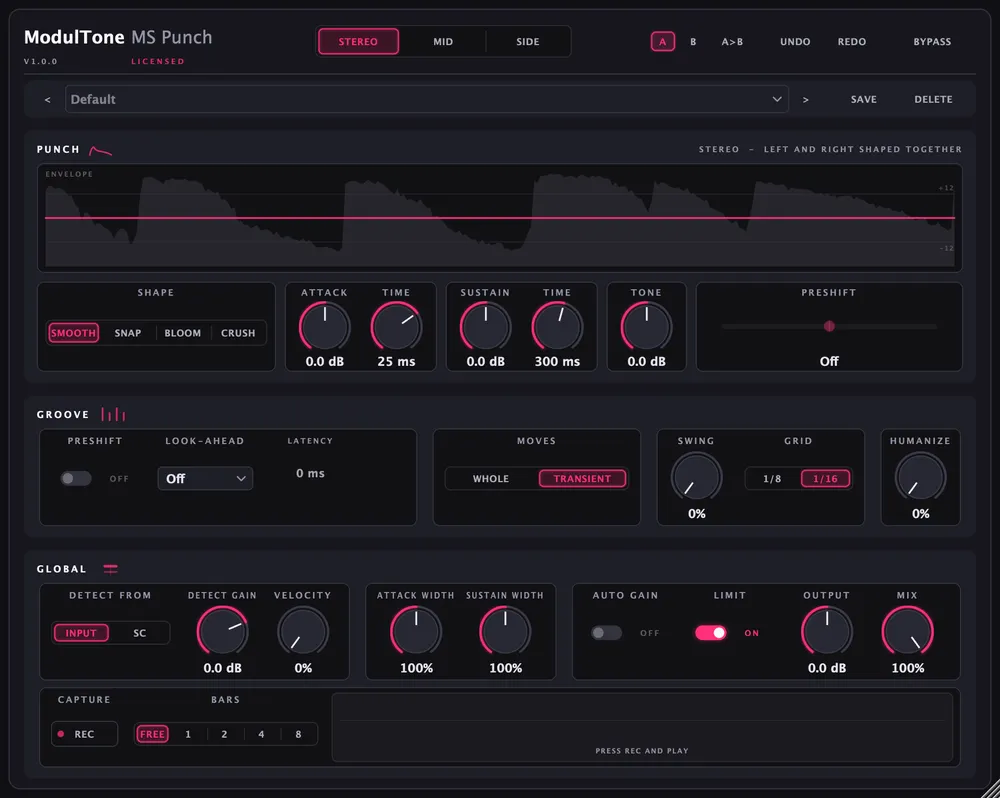
A drum bus where the kick and snare need more crack and the room mics already take up too much space. In Mid-Side mode the mid gets a few dB of Attack while Sustain comes down on the side, so the centre hits harder and the room between the hits gets shorter. Each lane runs its own detector for that: a transient shaper isn't linear, and one set of settings run on mid and side together would shift the stereo image on every hit. Stereo mode links left and right to one detector instead, so the image holds still. Every hit is split into its attack and its body, and the two always add back up to the whole signal, which means the plugin passes audio through bit for bit until you turn something. Then there is timing. Preshift moves a lane's attack ahead of the beat or behind it while the body stays where it was, Humanize nudges each hit by a few milliseconds and up to 3 dB, and Swing delays the off-beats on a 1/8 or 1/16 grid.
MS MultiComp
Multiband mid/side compressor plugin
Four bands, and the mid and the side get their own compressor in each.
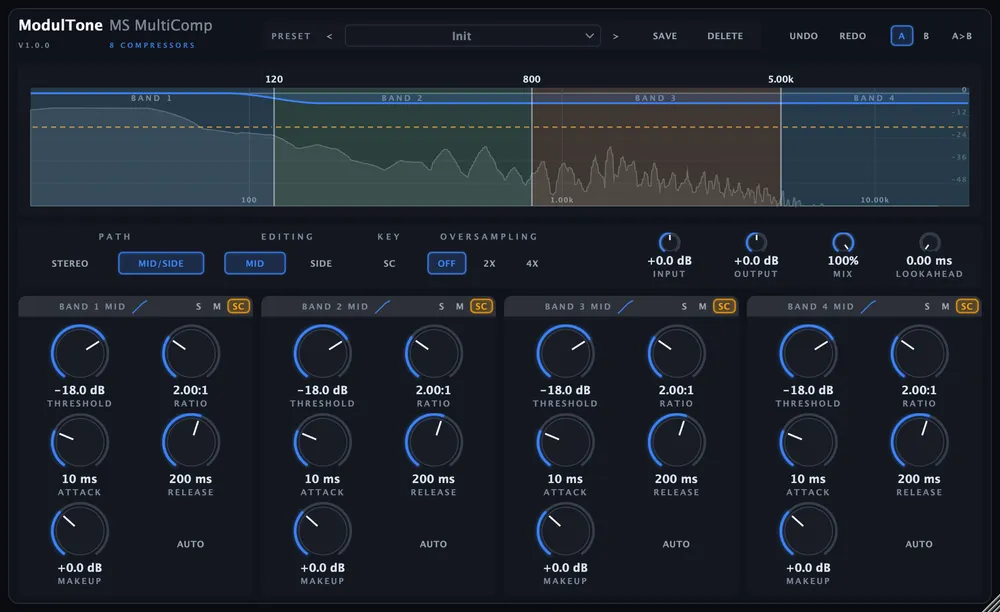
In Mid/Side mode this runs eight compressors: four bands wide on the centre and four on the sides, each with its own threshold, ratio and timing. The band around 120 Hz can squeeze the mid hard and leave the sides alone, which is where the low end goes when the bass is fighting a wide synth. Four bands, crossovers at 120 Hz, 800 Hz and 5 kHz to start, and a Stereo Multiband mode for when the mix doesn't need the split.
Made on my own sessions.
My name is Ivo Janssen and I'm a pop producer, mixer and songwriter. I made these plugins to quickly make my mix sound professional when I need it most. I tried making the controls as easy as possible while still giving you enough options to play with. The plugin MS Saturator came out of a chorus that wouldn't land: parts right, balance right, and the bus mix still sitting in the same narrow space as the verse. Everything since has come from that.
Read the longer versionWant to learn more about mid/side mixing?
What it is
The ideas, before you touch a control.
Where it goes
What to do at one particular point in a mix.
How to do it
The steps for one specific job.
Start with the free one.
MS Widener has the same goniometer as the paid plugins, so you can see what mid/side does to a track before you spend anything. One email address, no card.